By JEFFREY BLACKWELL
Center for the Study of World Religion
(Published March 4, 2025
he term “psychedelics” can conjure surreal images of mind-altering journeys through a mystical realm that connects the body to the soul and the soul to divinity. Dreamlike visions can pave the way for healing and transcendence, something Indigenous communities have understood for centuries. But only in the last decade did a “psychedelic renaissance” emerge in Western culture, underscoring the therapeutic potential of entheogenic plant medicines.
The Center for the Study of World Religions (CSWR) is at the forefront of this resurgence as the medical, recreational, and spiritual use of psychedelic drugs, plants, and fungi weaves into Western mainstream culture after decades of criminalization in the United States and beyond. As part of the Harvard Study of Psychedelics in Society and Culture, the CSWR is working to advance understanding and innovation of the psychedelics landscape through scholarship, programming, and collaborative research with Indigenous communities.
The interdisciplinary Harvard Study, established in 2023 with a $16 million gift from the Gracias Family Foundation, brings together cross-Harvard collaborators from the Faculty of Arts and Sciences, Harvard Law School, and Harvard Divinity School. Students, faculty, staff, researchers, scholars, and experts are examining psychedelics using a multifaceted approach that includes social, legal, ethical, and scientific perspectives, as well as art, literature, religion, and spirituality.
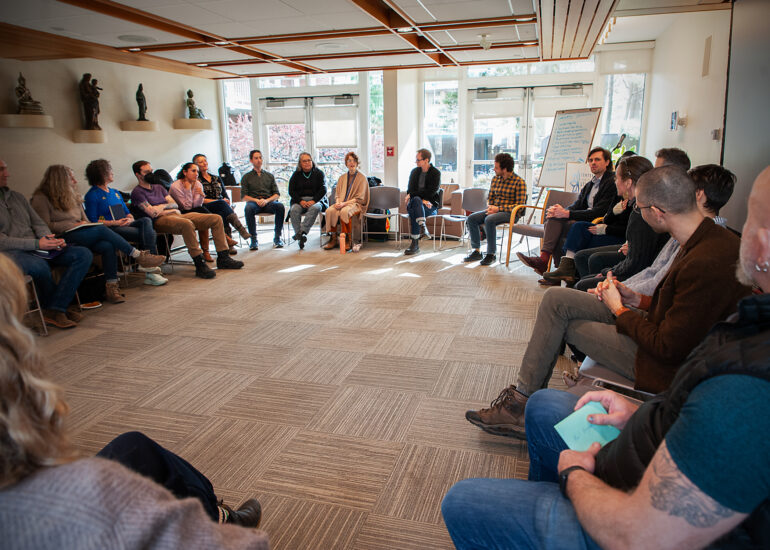
Since 2021, scholars from the CSWR have focused their efforts on the intersections between psychedelics and spirituality through a series of programs that promote academic investigation and the cultures surrounding it. The Center’s third annual Psychedelic Intersections conference, “Psychedelic Intersections: Betwixt and Between Chaplaincy, Plant Medicine, and Aesthetics,” commenced on Feb. 15 with a one-day summit at Harvard Divinity School, attracting more than 1,000 scholars, practitioners, experts, and policymakers from 24 countries, both in person and online, to advance the mission of psychedelic scholarship.
“The Center for the Study of World Religions is delighted to be a part of this cross-campus collaboration, and we are especially pleased to work alongside our partners, the Mahindra Humanities Center and the Petrie-Flom Center for Healthcare and Policy at Harvard Law School,” said Charles M. Stang, Director of the Center for the Study of World Religions, and Professor of Early Christian Thought at the Harvard Divinity School. “The Center’s programming in psychedelics and spirituality is part of a broader initiative that we call Transcendence and Transformation.”
This year’s conference emphasized three research tracks: psychedelic chaplaincy, the traditions surrounding Indigenous plant medicines, and psychedelic art and aesthetics. The diverse speakers and attendees included international scholars, legal and medical experts, and Indigenous practitioners. Mazatec community member Elías García Méndez opened the conference. Marian Goodell, the Chief Executive Officer of the Burning Man Project, delivered the closing address. A conference workshop on the process of psychedelic archival and research offered attendees a closer look at items in the University’s psychedelics collection. Harvard has the most extensive collection of drug-related literary paraphernalia in the world—more than 50,000 items from the 1960s and 70s—a gift from the family of Julio Mario Santo Domingo Jr. in 2012. An exhibit at the Houghton Library is slated for fall 2027.
“This conference, like all of our psychedelics programming research, strives to be multidisciplinary and collaborative, to be engaged with and to extend beyond the academy to be optimistic but self-aware and to be equal parts compassionate and rigorous,” said Jeffrey Breau, CSWR Program Lead, Psychedelics and Spirituality. “We keep a critical eye on issues of ethics and risks but believe that arguments are strongest when they come from a place of sympathetic understanding that challenges outdated assumptions and legal statuses as a result of the war on drugs.”
Beyond the idyllic vision portrayed in popular culture, there are legal, ethical, and practical questions surrounding psychedelics such as ketamine, ecstasy (MDMA), LSD, and psilocybin mushrooms. While Indigenous Peoples have used natural psychedelics for centuries, the practical, ethical, and cultural issues remain a source of debate worldwide.
“A collaborative effort between people of Indigenous communities and scholars should set the tone for how scholarship like this should happen,” said Paul Gillis-Smith, CSWR Program Lead, Psychedelics and Spirituality. “Where does more critical attention need to be? What are people interested in? Having a container for psychedelic conversation every year, we can bookmark and index those points.”
Keynote speaker Elías García Méndez is co-founder of Casa Adobe, the first art collective in Huautla de Jiménez, Oaxaca, Mexico—a foundational community in the global understanding of the healing properties of psilocybin mushrooms. The town was also home to María Sabina Magdalena García (1894-1985), a healer, shaman, and poet who helped popularize the Indigenous Mexican ritual use of mushrooms among Westerners.
The community’s ritual healing traditions date back centuries and are woven deep into the Mazatec life and culture. Practiced by Mazatec elders who work with the community to facilitate healing, the elders, or “healers,” serve as guides and open portals to spirits and nature, Méndez said through an interpreter.
“It’s extremely important that (the healer) be filled with very good energy, with very good intention. So many people come to the healers when they have some sort of a disease, whether it be spiritual, whether it be physical, emotional, and the healer has to know how to make the best of that good energy before the ceremony begins,” he said.
Erika Dyck, a professor and Canada Research Chair in the History of Health & Social Justice at the University of Saskatchewan, participated in the panel discussion, “Indigenous Plant Medicine Traditions of the Americas” along with her colleagues, Reanna Daniels, a PhD candidate at the University of Saskatchewan, and Kelly Daniels, a Plains Cree from Sturgeon Lake, Saskatchewan. They examined the history of peyote-based ceremonial practices in North America through the lens of the Native American Church.
“I think that some of the examples that we’ve seen here today, and certainly that exist historically suggest that (Indigenous people) are thinking about healing in a way that challenges some of what we think of in terms of Western biomedicine,” said Dyck. “It’s heartening to see (the CSWR) putting together this conversation because I think it catalyzes imagining how we might open our minds and hearts to the way that ceremony might be a useful way to think about healing.”
Kelly Daniels, raised in the traditions of the Sturgeon Lake First Nation, said tribal elders taught him about the traditional and sacred ceremonies of the Cree Nation, as well as the natural medicines used in those healing practices.
“These wonderful medicines that we have are a continuous learning experience that took our ancestors a lifetime to learn,” said Daniels. “It’s our turn to make that understanding with these medicines, the growth and the season, and the practices of approaching the heart. And you learn as an individual how to care in love for the nature of those medicines.”
Breau said the field of psychedelic studies has advanced significantly since the onset of the War on Drugs in the 1970s. However, even amidst open and bold discussions, he emphasized the importance of recognizing how rare it is to be in a space crossing and challenging disciplinary boundaries.
“These substances remain criminalized,” he said. “We may not all agree on the best ways to balance safety and liberty, but I hope you will keep in mind that intelligent and sympathetic research is not just a scholarly endeavor. It is a moral imperative.”
Banner photo: Elías García Méndez, co-founder of Casa Adobe, the first art collective in Huautla de Jiménez, Oaxaca, Mexico, speaks through interpreter Emily Getchell about the significance of community elders and healers in ritual healing using psilocybin mushrooms. Méndez was a keynote speaker at the Psychedelic Intersections 2025 Conference at Harvard Divinity School on Feb. 15. Photo by Ashley Zigman.