Photo by Ashley Zigman Borders
By JEFFREY BLACKWELL
Center for the Study of World Religion
(Published December 11, 2024)
Harvard’s Center for the Study of World Religions invited the world to a two-day groundbreaking summit on the life and work of twentieth-century mystic and spiritual teacher George Ivanovich Gurdjieff, and thousands of scholars, practitioners and the curious from around the globe responded.
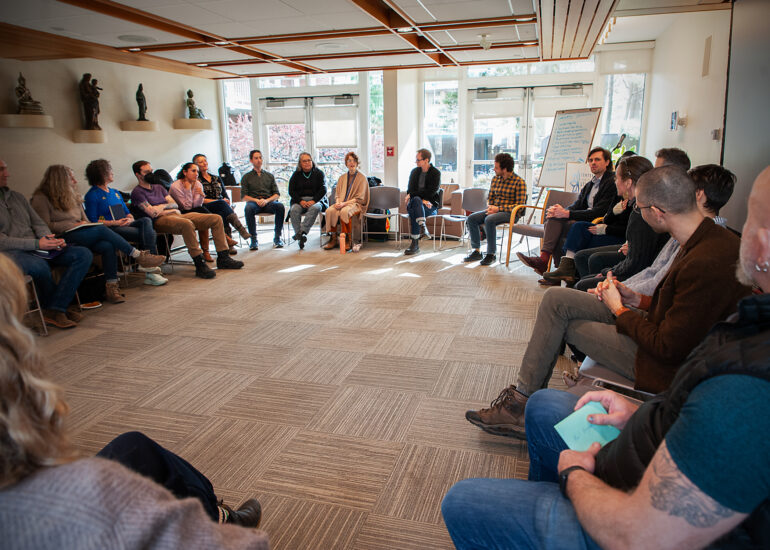
On Dec. 4 and 5, more than 300 people from as far as Europe, South America, and the United States attended the conference at the Harvard Divinity School in person, while more than 2,000 people from 40 countries watched online. The conference, the largest of its kind and marking the 100th anniversary of Gurdjieff’s visit to Harvard University in 1924, featured leading scholars, academics, and representatives from the Gurdjieff Foundation and independent centers.
“This 100-year anniversary gives us the occasion, maybe even the mandate, to reflect on G. I. Gurdjieff’s long legacy and how it has grown and evolved since 1924 and influenced so many other movements, social, spiritual, and creative,” said Charles Stang, Director of the Center for the Study of World Religions and Professor of Early Christian Thought at the Harvard Divinity School, in his opening address. “The Center has sought to bring together scholars and practitioners and a fair number of scholar-practitioners, those who are a part of and apart from Gurdjieff’s lineage, and perhaps, those who don’t often engage.”
Gurdjieff (c. 1866-1949) was a Greek-Armenian mystic, spiritual teacher, composer, and dance teacher who led an international movement to awaken people to higher consciousness and humanity. In 1924, he and 23 of his students visited Harvard as part of a tour of U.S. cities, including New York, Boston, and Chicago, to perform “demonstrations” of sacred dances and music.
The worldwide Gurdjieff movement continues today, with members of the Gurdjieff Society of Massachusetts, the Gurdjieff Foundation of New York, and the Institut G.I. Gurdjieff in Paris partnering with the CSWR on the conference. The event’s focus was to provide a greater understanding of the movement, its teachings, and its followers and to provide a forum for discussion between scholars and practitioners.
Alexandre de Salzmann, a French physician and President of the Institut G.I. Gurdjieff and the International Association of Gurdjieff Foundations, spoke at the opening ceremony and presented at one of several panel discussions and presentations. He is the grandson of Jeanne de Salzmann, one of Gurdjieff’s devoted students, and grew up in the heart of the community with his practicing parents.
“Some people say we are far from the source a hundred years ago. In fact, no, we’re not,” said de Salzmann. “The minute we’re really present is when we can say we’re within. So, before all the books, [Gurdjieff’s teachings] were part of an oral tradition, and the conference is also oral sharing, so it’s very important to have this opportunity.
Gurdjieff was born in Armenia in the late 1860s/70s and died in 1949 in France. The details of his life as a young man are uncertain. However, in his writings, he said he traveled extensively through Central Asia, India, Egypt, Iran, and Tibet to learn about various spiritual traditions and teachings. He began teaching in Moscow and Petrograd in 1913 before the Russian Revolution, eventually moving to Fontainebleau, France, in 1922, where he established the Institute for the Harmonious Development of Man. There, he taught his students that people lived in a perpetual “sleepwalk” and could be awakened to a higher state of consciousness through his teachings, movements (dance), and music, called “The Work” or “The Fourth Way.”
The conference was also significant because it brought together Gurdjieff communities from various teaching lineages and scholars from both inside and outside the movement, each of which has protected its traditions and teachings. Visiting Scholar Carole M. Cusack, a Professor of Religious Studies at the University of Sydney in Australia, partnered with the CSWR to host the international conference and help bring together Gurdjieff communities that rarely interact. She has written and researched extensively on Gurdjieff and organized a similar but smaller conference in 2019 in Sydney.
“I think we are making history,” Cusack said in her opening address. “[Previous conferences] were tiny compared to what we have been able to bring here, and that means the impact must be greater. Even if only 10 percent of people in attendance take away something that changes the way they think, the way they want to live, the things they want to devote themselves to, then we will have succeeded.”
The conference opened on the evening of Dec. 4 at the Harvard Science Center, with introductory speeches by Stang, de Salzmann, and Cusack, followed by the screening of a documentary by Jean-Claude Lubtchansky, “George Ivanovich Gurdjieff: The Seekers of Truth.” The second day of the conference focused on Gurdjieff’s legacy in his writings and the writings of others, the scientific influences of his teachings, the societal value of his teachings, and the exploration of his music and dance movements. The conference concluded with a piano recital of music written by Gurdjieff and collaborator Thomas de Hartmann.
Constance A. Jones, a professor at the California Institute of Integral Studies in San Francisco, helped organize a Gurdjieff conference in 2007 and has written extensively on Gurdjieff. She said of this gathering, “[It] is very interesting because it’s a combination of practitioners and those who study the ideas of G.I. Gurdjieff. And those ideas are not simple: they’re very complicated,” Jones said. “He has a cosmology, he has a psychology, he has a chemistry, he has a physics, he has a music, he has a movement, a dance, all of those. He’s a pro in all of those fields. So that’s what they’ve done here: bring this whole spectrum into view with some experts in each and every field. It’s beautiful.”
Andrew Breitenberg, president and chairman of the Claymont Society in West Virginia, a center dedicated to continuing education in Gurdjieff studies, said he hopes the conference will improve connections between Gurdjieff societies and groups and help introduce and build interest among a new generation of students.
“I think this conference is remarkable, most especially because I’ve seen a generosity and a receptivity and an openness, in what up to now have largely been separated factions within this great work,” Breitenberg said, “As a younger person in The Work, and as someone who has had their life changed completely by this spiritual transmission, I’m very encouraged by the interest from these older community members in transmitting what they have.”
Roberta Chromey traveled to the conference with her husband, Jack, from West Virginia. In the early 1970s, she was drawn to Gurdjieff’s teachings. She wrote a book about her experiences at Gurdjieff scholar J. G. Bennett’s school in England, entitled Real People: At the Pinnacle with Irmis Popoff and the Second Basic Course at Sherborne House with J.G. Bennett: A Memoir (Red Elixir, 2022).
“I was looking for family at the time, and I resonated with what was being transmitted and said in his teachings,” said Chromey. “This is a stellar event with the gravitas and expertise.”
David Elliot, who traveled from France to attend the conference, said he became involved in the movement through his parents, who met at Gurdjieff’s apartment in Paris.
“So that’s why I’m here. Literally,” he said. “I stayed with it, followed a path that has become very central to my life.”
Gosia Sklodowska, Executive Director of the Center for the Study of World Religions at Harvard Divinity School, said the conference resulted from two years of meticulous planning, including public Gurdjieff dance workshops and reading groups.
“I believe that all of us here today went beyond the superficial, the sensational, and the habitual, delving deeply into an understanding of The Work and appreciating the Fourth Way as a compelling philosophy and way of life,” she said.