Thinking with Plants and Fungi: Celebrating the Voices of the More-Than-Human World

By JEFFREY BLACKWELL
Center for the Study of World Religion
When hundreds gathered at the Harvard Divinity School in May for a three-day conference on the sentient lives of plants and fungi, Ralph Waldo Emerson, Emily Dickinson, Henry David Thoreau, and generations of Indigenous people may not only have recognized the conversations, but they would have also applauded them.
From May 15 to 17, the Center for the Study of World Religion’s (CSWR) Thinking with Plants and Fungi Conference was an immersive, in-depth exploration into the consciousness and agency of the more-than-human world: trees, plants, and fungi. Thinking with Plants and Fungi, an initiative at the Center for the Study of World Religions, explores how inquiry into plant and fungal life illuminates the nature of mind and matter and examines humans’ relationship to the more-than-human world.
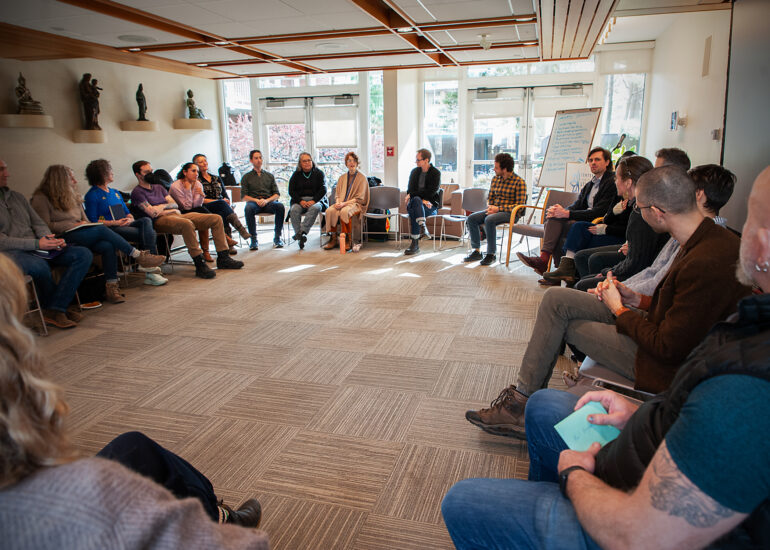
The event attracted a broad spectrum of scholars, artists, and practitioners from around the world, representing various disciplines within the humanities and social sciences, all of them focused on the complex relationship between humans and the interconnected community of plants and fungi that surrounds us.
The concept of being in community with plants and fungi is not new; the idea that all life-forms in nature are intertwined with human life is at the center of Indigenous cultures around the world, ancient European traditions, and is the subject of writings by local naturalists, such as Emerson, Dickinson, and Thoreau.
“I think they would be surprised, maybe pleasantly surprised, because I do think that they felt many of the things that are being expressed today,” said Michael Marder, Research Professor in the Department of Philosophy at the University of the Basque County, and conference keynote speaker on the plant thinking of Emily Dickinson. “So maybe what we’re doing here is not something new. We’re catching up with something older, definitely older than even the nineteenth century of Dickson.”
The conference drew more than 1,500 participants, both in person and online, for a series of panel discussions and keynote speakers addressing a wide array of subjects, including the history of plant neurobiology, ancestral human relationships with fungi, forging a future with plants and fungi, Emily Dickinson’s plant thinking, and much more.
“We are enormously proud to host this historic conference, which is the culmination of many years of hard work, but also many years of walking, wondering, and wandering together,” said Charles M. Stang, Director of the Center for the Study of World Religions, and Professor of Early Christian Thought at the Harvard Divinity School. “This conference is the fruition not only of the Thinking with Plants and Fungi initiative of the past 18 months, but of many years of the Center’s commitment to an investment in religion and ecology.”
Rachael Petersen, MDiv ’24, Program Lead of the Thinking with Plants and Fungi initiative, stated that the speakers and panelists were intentionally selected to represent various facets of exploration and inquiry into the ecosystem of plants and fungi.
“From stink horns to mosses, from mold to copal, from philosophy to biology, from literature to philosophy, from morels to morals, we are going to cover a lot of ground together,” Petersen said in her opening conference address. “This is a dynamic living ecosystem of thinkers we’ve assembled here in front of me today, and I think, as most of us in this room probably know, diversity is strength when it comes to ecosystems.”
Merlin Sheldrake, a biologist, author, Director of the Impact Society for the Protection of Underground Networks, and presenter of the documentary Fungi: A Web of Life, was the conference’s opening keynote speaker, interviewed by Petersen. His New York Times and Sunday Times best-selling book Entangled Life: How Fungi Make Our Worlds, Change Our Minds and Shape Our Futures (Random House, 2020) focuses on fungi’s life cycle, the evolutionary role fungi play in plants, and the relationship between humans and the fungal community.
Sheldrake’s latest work is a study with a group of researchers at the University of Amsterdam on how mycorrhizal fungi build networks in self-regulating waves. The findings were recently published in a paper titled “Traveling Wave Strategy for Mycorrhizal Fungal Growth” (Nature, Feb. 2025). The project utilized imaging robots to capture serial time-lapse images of fungal networks in 40 separate dishes simultaneously, providing a century’s worth of data in just three years, including the dynamic, bidirectional ways of transporting materials through a complex traffic system where fungi can regulate speed and direction depending on need or the challenges they face at the moment.
“What this allows us to show in this paper is that these fungi are able to forage. Their foraging strategy involves exploring outwards,” Sheldrake said. “They have these growing leader tips that explore outward in search of new plant partners, and they have a kind of wave of densifying mycelium behind these growing tips that allows them to harvest and forage for phosphorus and other nutrients in the soil, and this behaves in a kind of wave.”
The metaphor often used to describe this kind of research is the “Wood Wide Web,” the network of mycorrhizal fungi that form symbiotic relationships with plant roots, providing them with nutrients in exchange for sugars produced through photosynthesis. The concept, which Sheldrake supports, is sparking a debate about how we talk about plants and fungi.
“I think this touches on the way that we talk about symbiotic relationships and ultimately the way that we make sense of the living world,” he said. “Is nature fundamentally cooperative? Is it fundamentally full of conflict? What do those different readings of the living world tell us about ourselves? How can we naturalize our behavior in the living world based on how we understand the answers to those questions? These debates have been raging since the works and viruses were brought into biology in the nineteenth century. I think part of this, what’s going on here, is an ignition of an old and emotional debate about trying to understand ourselves in relation to the living world.”
Much of the conference focused on how to define and what language to use to address the expanding knowledge of the mysterious lives of plants and fungi. How do we best conceptualize and describe the scientific evidence that the more-than-human species communicate and problem solve in their respective environments? How do we readjust our thinking about these life forms?
Keynote speaker Monica Gagliano is a renowned research scientist, recognized for her pioneering work in plant communication, cognition, and subjectivity. She is a Research Associate Professor (Adjunct) in evolutionary ecology at Southern Cross University in Lismore, Australia, and author of the book Thus Spoke the Plant: A Remarkable Journey of Groundbreaking Scientific Discoveries and Personal Encounters with Plants (North Atlantic Books, 2018).
Gagliano was part of a recently released study in the Italian Dolomites that found groups of trees respond to a solar eclipse by synchronizing their bioelectrical signals hours in advance in a coordinated response in the forest.
“If this were an animal system, we would say that what happened 14 hours before would be called anticipation, which is a key feature of synchronicity,” she said. “So, synchronized behavior, which is what you would see when birds flock together, or a school of fish, and what we see when we all synchronize in a dance or something, there is an anticipation. So basically, this was amazing.”
Mary Tucker, Co-Director of the Yale Forum on Religion and Ecology at Yale University’s School of the Environment, said that this conference and the discussion are vital due to the ongoing mass extinction of plants, fungi, and their associated ecosystems around the world.
“We are in the midst of a mass extinction called the ‘Sixth Extinction Period,’ which by and large, the public, both in Europe and in the U.S., doesn’t really know,” said Tucker. “This rapid, relentless loss of species is happening, and has to be more foregrounded in our thinking. The ethical import of biodiversity as something to be valued and the loss to be connected a little bit more with larger issues and movements in this direction, I think, is hugely important.”
The Arnold Arboretum of Harvard University has many endangered species of trees and plants in its collection. Keynote speaker William (Ned) Friedman, Director of the Arnold Arboretum and Arnold Professor of Organismic and Evolutionary Biology at Harvard University, said that out of 16,000 different species at the Arboretum, 3,000 are endangered.
“We are a safe harbor for species that are extinct in the wild. Like the Franklin tree,” he said. “We are a force for conservation and fighting extinction around the world, and we are a safe harbor for threatened species.”
The curator of the Woodlawn Cemetery Arboretum in Bronx, N.Y., Rebecca McMackin, was a member of a conference panel discussion on creating an ethical future with plants and fungi. She said it was refreshing to be part of a conference where people are thinking deeply about the issues surrounding the recognition of plants and fungi from so many different perspectives.
“It is literally the best conference I’ve ever been to,” said McMackin. “I’m in a little bubble of horticulture, and there are people who think deeply about gardens and gardening in plants and animals and all of that stuff, and engage with these topics. But I’ve certainly never been in a realm that brings in so many different disciplines and is still centered around love and shared values. I’m going to go back. I’m going to change all my thinking, and I’m going to go and talk to the people and do it again.”
The three-day conference explored a dynamic range of topics, from emerging scientific discoveries to poetry and novels from the perspective of plants and fungi. It also provided an opportunity for participants and attendees, during breaks and a tour of the Arnold Arboretum of Harvard University, to exchange ideas, network, and engage in peaceful disagreement.
“Today we have another full day of richly provocative encounters ahead a day that will keep asking us not just to think about plants and fungi, but to let our very thinking become more plant-like, rooted in reaching slow and sudden, distributed, generous, alive,” said Russ Powell, Research & Program Specialist for Thinking with Plants and Fungi initiative, at the opening of day two of the conference. “I’m attuned to the ambivalence surrounding the idea of retreat. In the American environmental tradition, in particular, retreat is both celebrated and scrutinized. And indeed, Henry David Thoreau, just a few miles from where we’re gathered right now, built his cabin at Walden Pond to do precisely that. And that’s what I kept hearing yesterday, not escapism, but commitment, a retreat away, sure, but also toward perception, attention toward the humility and honesty required to meet more than human life on its own terms.”
The results of this conference will steep and percolate in the minds of the artists, scholars, scientists, and others who were part of this vital gathering, forming a new network of connections, much like the mycorrhizal fungi that partner with trees and plants in the forest.
“I think the culmination of thought or feeling of the space was that the interdisciplinary approach is so valuable and allows for more creative conversations on solutions, if those can even exist, when we move forward, looking at the environmental polycrisis,” said Natalia Schwien, Advisor and Program Associate, Thinking with Plants and Fungi, and leader of the initiative’s reading group. “And so when you get everyone together and you realize we’re all in conversation with each other, but also there are all these beautiful bridges that can be reached across where we can reach towards each other and say, ‘I see something similar happening in your work. How can we work together to find a way to articulate it.’”