By JEFFREY BLACKWELL
Center for the Study of World Religion
(Published October 17, 2025)
In the mid-1830s, a group of New England Unitarian ministers, writers, philosophers, and intellectuals, including Ralph Waldo Emerson, Amos Bronson Alcott, Margaret Fuller, Elizabeth Palmer Peabody, and Henry David Thoreau, along with other thought leaders of what eventually came to be known as the Transcendentalist movement, met sporadically in Concord, Massachusetts to discuss the society of their age.
The group was called the Transcendental Club or “the Brotherhood of the Like-Minded.” Although it lasted only a few years, through those meetings and the publication of a journal called The Dial, it provided a circle and platform for intellectual thought and discussion.
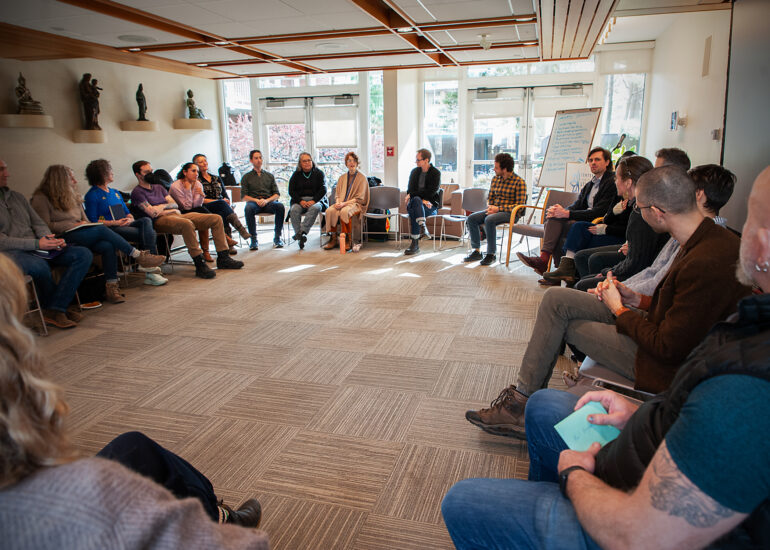
The Center for the Study of World Religions at Harvard Divinity School (CSWR) organized a collaborative two-day workshop in October, examining the legacy and future of Transcendentalism in an open discussion reminiscent of those spirited meetings of the Transcendentalists nearly 200 years ago.
“In a lot of ways, the focus is not to have a focus. It’s for our conversations to provide the focus,” said Russell Powell, CSWR Research Affiliate for the Transcendentalism Initiative. “We are trying to convene these conversations precisely so that the people most invested in Transcendentalism as a living legacy can help to set our bearings for what the study of Transcendentalism, today and in the future, can and should look like.”
Nearly 30 scholars, practitioners, artists, and others from across the United States, and as far as Sweden and Denmark, gathered at the Concord Museum in Concord, Massachusetts, where Thoreau’s desk and wooden flute are on display. The museum is located in the heart of town, which gave birth to the Transcendentalist community, about three miles from Thoreau’s Walden Pond, less than a block from Emerson’s home, and a short walk from Sleepy Hollow Cemetery, where many of the Transcendentalists are buried.
“We were trying to gather scholars of Transcendentalism who we suspected were also not just scholars of, but part of the tradition that we’re committed to carrying forward,” said Charles Stang, Director of the Center for the Study of World Religions, and Professor of Early Christian Thought at the Harvard Divinity School. “These people have skin in the game. They feel aligned and affiliated with the movement.”
The workshop format included short presentations (called “seed talks”), panels, small group discussions, and experiential opportunities in and around Concord, all aimed at discovering a pathway from scholarship to the practical application of Transcendentalist philosophy. The seed talks were given by Powell, Rebecca Kneale Gould, a scholar of religion and Associate Professor of Environmental Studies at Middlebury College, in Vermont, and Jane Bennett, the Andrew Mellon Professor of Humanities at Johns Hopkins University.
John Kaag, Professor of Philosophy at the University of Massachusetts Lowell, asked during his seed talk what knowledge, ideas, and talents participants could share to advance the Transcendentalist ideas on self-reliance and humans’ connection to the natural world.
“We are at a bonfire with things to share, and if we do not succeed tremendously, we will have failed terribly,” he said. “What have we brought to share, what practicable, actionable talents do we have to offer each other? Figuring that out, right now…might be the most significant aspect of this conference.”
The conference served as a starting point, according to participants. It was not designed to announce discoveries, uncover history, or break news in the biographies of nineteenth-century Transcendentalist thought leaders. It was a deep dive into the possibilities of bringing light to a historical, philosophical, and practical movement that could provide valuable insight in this challenging moment in history.
“The workshop’s format is reminiscent of Margaret Fuller’s ‘Conversations’ in Boston from 1839–1844, where, as a pioneering editor of The Dial and a member of the Transcendentalist Club, she fostered open, participatory discussions, or a ‘nucleus of conversation,’” said CSWR Executive Director Gosia Sklodowska. “Embracing her democratic spirit, our workshop felt especially meaningful as we reflected on the legacy of Transcendentalist thought. Paraphrasing Ralph Waldo Emerson’s words after his first meeting with Fuller, our conversations felt expansive, allowing us to stretch our limits and dilate to our utmost selves.”
Gould, who grew up in Concord, said the value of the format was in the small group discussions prompted by lists of provided questions for each breakout session. The questions included, for example:
What of today’s contexts, considerations, and crises (ecological, political, spiritual, epistemological, e.g.) make Transcendentalist thought urgent to return to—or not?
How do contemporary movements—environmentalism, decolonial thought, democratic theory, feminist philosophy, etc.—intersect with, or diverge from, historical Transcendentalist concerns?
What dangers are there in reviving Transcendentalism now?
“I think there’s so much value in how they decided to structure this—to have a few people speak, and to have mostly discussion and probing questions. What we brought to the questions changed over time with new insights and new discussions,” said Gould. “And the fact that Margaret Fuller had her conversation circles, that the Emersons had people in their home, that Thoreau had way more visitors [to his house at Walden Pond] than most people think. We were actually following the legacy of their structure of how they benefited from each other, agreeing, disagreeing, fighting, whatever.”
The weekend workshop also took an experiential dive into local sites connected to the Transcendentalists, including tours of Walden Pond, the Concord Museum, Ralph Waldo Emerson’s home, October Farm Riverfront Trail, and Sleepy Hollow Cemetery.
Nearly a dozen participated in the tour of Walden Pond, where Thoreau lived alone near the shore of the pond for two years. The experience formed the basis for his 1854 book Walden; or, Life in the Woods. The tour was led by Robert Thorson, a geologist and Professor of Earth Sciences at the University of Connecticut, who is interested in the intersections of landscape geology, archaeology, environmental history, and American literature, especially the work of Thoreau. Thornson wrote The Guide to Walden Pond (Houghton Mifflin Harcourt, 2018), the first guidebook to Thoreau’s most defining place.
Much of the landscape surrounding Walden Pond has changed since Thoreau’s time. A beach and parking lot were built to give the public access. A trail was cut around the pond and to the site of his home. But much of the geological terrain is unchanged, including the depressions left by the melting of glacier ice, which also helped create the pond. The area near the site of his one-room house is also relatively unchanged.
“He was there digging holes and climbing hills and swimming in the pond. He saw quite a bit of that northwest quadrant, like it is today,” said Thorson. “I’m trying to get across to the group that the geology matters. It’s called environmental determinism. It called to Thoreau in his writing and would have given rise to a different text if he had written it somewhere else.”
Eastern Massachusetts is central to the landscapes of the Transcendentalist movement. Emerson and Thoreau were from Concord and both graduated from Harvard; the Transcendentalist Club sometimes met in Boston, and a group of them even started an experimental community in West Roxbury, Brook Farm.
Susan Shumaker, a producer and story developer with Florentine Films and Ewers Brothers Productions, recently completed a documentary about Henry David Thoreau with filmmakers Erik and Chris Ewers, executive produced by Ken Burns and Don Henley. She said she was drawn to the conference in part because of the scholars attending and the workshop’s location in Concord.
“I have come to know much of this cast of characters over the last five years or maybe six years that I’ve been working on the film, and have just fallen in love with this community and with this study,” she said. “I hope there is a way to bring people back into connection with self, with nature, with the world, with—dare I say—God. I am not thinking of a guy with a white beard in heaven, but rather of that connectivity that we feel in certain circumstances that somehow comes to us as a gift. For me, that’s often in nature, but sometimes it’s with family. It’s that interconnection with people and places, the land, trees, and—from that connection—living justly on the land: caring for others, caring for our planet.”
What happens after this two-day summit will be shaped by the participants through the new connections and networks developed in the heart of Transcendentalism’s origin.
“This has been, I think, an unprecedented success for us, and I only hope that I feel that way a month from now, six months from now, 18 months from now, some of the proof will be in the pudding,” said Stang. “We’ll see where this goes.”